Broker and agent pathways

MarketLink pathway architecture for broker, agency, agent, and consumer enrollment.

A production-facing walkthrough of the MarketLink operating model: broker onboarding, agency hierarchy, agent-scoped books of business, white-label consumer enrollment, CMS EDE transactions, protected-data controls, and the evidence trail needed for a regulated ACA platform.

Architecture Broker desktop, consumer portal, CMS Hub, carrier EDI, and evidence stores.

Shows where users enter, where data lands, and where transactions leave the platform.

Security Identity, MFA, RBAC, agency isolation, encryption, audit, and HMAC events.

Maps controls to the actual release code and CMS broker-agent requirements.

Walkthrough Dashboard, clients, applications, plan shopping, consent, agency, and compliance views.

Shows the operating path from platform access to enrollment evidence.

MarketLink pathway view Walkthrough-ready architecture
01 Public and branded entry

Agency or broker branded URL, consumer registration, account activation, identity proofing, and portal home.

/b/<slug> -> /portal/register -> /portal/verify-identity
02 Broker workspace

Dashboard, clients, leads, applications, exports, analytics, commissions, payments, book, marketing, agency, and consent.

/dashboard, /clients, /applications, /agency, /consent
03 Security control plane

Geo gate, public-route allowlist, rate limits, CSRF, Okta/IAL2, MFA, registration status, and route-level RBAC.

middleware.ts + NextAuth + API helpers
04 CMS EDE service layer

Marketplace plan data, Hub API modules, mTLS transport, circuit breakers, idempotency, evidence capture, and webhooks.

cms-hub/apis/* + cms-marketplace-api.ts
05 Evidence and data foundation

Prisma/PostgreSQL schema, encrypted PII, masked response boundaries, audit hash chain, document retention, and 834 tracking.

schema.prisma + encryption + audit services
Architecture view

Broker/agent pathway architecture connects users, controls, product functions, CMS transactions, and evidence.

This view is based on the MarketLink release source. It separates user entry paths from the authenticated broker desktop, then shows the control layer, domain services, persistence boundary, CMS/FFE integrations, carrier EDI outputs, and audit evidence.

MarketLink Broker / Agent Pathway Architecture ACA broker operations, agency hierarchy, white-label consumer entry, CMS EDE transaction services, and evidence controls. Users and entry Agency owner OWNER / ADMIN Licensed agent AGENT / SUPPORT Consumer Portal account White-label URL Agency or broker slug /b/<slug> Auditor Compliance evidence Edge and identity Ingress guard Geo, public routes, assets NextAuth Okta, IAL2, JWT MFA and proofing TOTP, RIDP/RBA gate Registration gate NPN, RCL, approval Route RBAC OWNER / ADMIN gates Product experiences Dashboard KPIs, checklist Agency Members, NPN Clients Book, leads Apps Draft, submit Plans APTC, CSR Consent AOR, TCPA Consumer portal Profile, enroll, notices, life events Compliance and artifacts Domain and API services Route handlers + Zod Validation, errors, audit context Broker context brokerId, agencyRole, userType CMS Marketplace API Plans, counties, SLCSP, cache CMS Hub adapters 22 API modules, mTLS, circuit breakers 834 builder and carrier files Data, evidence, externals PostgreSQL / Prisma Users, brokers, clients, apps Encrypted PHI/PII AES-256-GCM, masked response Audit hash chain prevHash, rowHash, AU-09 Hub evidence folder Req/res metadata, correlation ID CMS, NIPR, carriers EDE, license checks, 834/999 Protected-data access, enrollment mutations, Hub calls, route decisions, consent, DMI/SVI, and EDI outputs feed the evidence layer
Security architecture

The pathway is controlled by layered identity, authorization, privacy, API, and evidence gates.

The control pattern is not just login. Requests are filtered before authentication, sessions carry producer and consumer context, routes enforce broker versus portal surfaces, APIs scope data to the authenticated broker, and every sensitive read or write leaves a compliance trail.

01 Ingress controls

Static asset allowlist, public route allowlist, country allowlist, auth rate limits, API rate limits, CSRF checks, CSP, frame protection, and strict referrer policy.

02 Identity assurance

Okta provider path with IAL2 intent, MFA enrollment and verification gates, identity proofing gates, password-change gates, and concurrent session supersession.

03 Role and pathway boundaries

OWNER, ADMIN, AGENT, SUPPORT, platform-admin, broker, and consumer surfaces are separated. Portal users cannot reach broker APIs, and brokers cannot access portal APIs.

04 Minimum necessary data

BrokerId and agencyId scoping, encrypted SSN/email/phone/address where implemented, masked SSN response, protected-data access logging, and protected-field re-proofing logic.

05 Tamper-evident evidence

AuditLog persistence, rowHash/prevHash chain, redacted metadata, protected-data read events, Hub request/response evidence, HMAC-authenticated inbound CMS events.

Broker / Agent Security Control Flow The platform evaluates entry, identity, registration, role, pathway, data scope, and evidence capture before a sensitive action completes. Request Broker, agent, consumer, auditor, CMS webhook. Ingress decision Asset bypass, public route, geo allowlist. Abuse controls Auth/API buckets, reset, signin throttles. Session identity Okta, JWT, brokerId, agencyRole, userType. Proofing gates MFA, identity proof, registration status. Pathway split Broker routes versus consumer portal APIs. Route RBAC Audit, EDE testing, approvals, agency admin. Data scope brokerId, agencyId, clientId ownership. Protected-data handling AES-GCM, masked SSN, sensitive access logs. Controlled business action Create client, save application, capture consent, submit EDE transaction, upload document, export evidence. Denied path 401, 403, pending review, proofing required, or route redirect. Evidence path Audit row, hash chain, Hub evidence, notification, task, or report.
Security documentation pack

BrokerPortal security review materials are packaged as architecture, controls, and release evidence.

These documents establish the security narrative, the control-to-evidence trail, and the testing artifacts needed to support architecture, risk, compliance, and release review.

01

Security Architecture Overview

Narrative architecture view covering ingress, identity, application controls, protected data, evidence lifecycle, and SecOps assurance.

Download DOCX
02

Controls and Evidence Matrix

Control matrix mapping identity, edge, application, data, vulnerability, continuity, and integration controls to evidence artifacts, owners, and review cadence.

Download DOCX
03

Testing and Release Evidence Checklist

Release evidence checklist covering threat model, SAST, SCA, secrets, DAST, vulnerability scans, access review, remediation, and approval criteria.

Download DOCX
Evidence boundary

Operating effectiveness is confirmed by attaching dated artifacts such as scan outputs, access reviews, WAF/TLS evidence, threat model approval, remediation tickets, and release signoff.

EDE transaction flow

Application, consent, plan shopping, submission, status, and carrier handoff are separate controlled steps.

MarketLink operates as a workflow system, not as a collection of disconnected screens. The value is the controlled sequence: identify the broker, prove the consumer, scope the data, capture permission, call CMS safely, track evidence, resolve DMI/SVI, and produce downstream enrollment outputs.

CMS EDE Broker / Consumer Transaction Flow A controlled sequence from branded entry or broker desktop to CMS Hub submission, evidence capture, status follow-up, and 834 carrier handoff. 1. Start path Broker desktop or white-label URL. /dashboard /b/<slug> 2. Attribute Resolve brokerId, agency, NPN, role. broker profile 3. Create record Client, household, application draft. clients applications 4. Shop plans County, SLCSP, APTC, CSR, cache. Marketplace API 5. Consent Electronic, written, AOR, permission. ConsentRecord 6. Proof identity Consumer proofing and protected gate. StoreIDProofing 7. Submit through Hub SubmitApp / SubmitEnrollment mTLS, circuit breaker idempotency, evidence files 8. Receive status GetApp, GetEnrollment, GetDMI, GetSVI, notices, events webhook. 9. Resolve issues Documents, policy update, tasks, consumer notices, DMI/SVI follow-up. 10. Downstream 834 enrollment file, 999, commission, exports, audit packet. Evidence spine: audit log, row hash chain, protected-data access events, consent record, CMS correlation ID, Hub wire evidence, DMI/SVI history, 834 transaction record, webhook receipts, downstream file acknowledgments, and support task history. status changes, DMI/SVI exceptions, or consent defects route back into the controlled workflow
Requirements map

Business requirements tie directly to platform functions, controls, and walkthrough views.

The traceability model connects ACA broker operations to the platform capabilities, controls, and evidence required to operate a governed enrollment pathway at scale.

Requirement area Platform function Security / evidence control Walkthrough view
Broker and agency onboarding Broker profile, agency profile, join code, member roster, lead-agent accountability, agency role assignment, NPN fields. Registration status gate, NPN/RCL fields, OWNER/ADMIN role control, audit log for role and profile changes. Dashboard checklist, Agency, Settings.
Agent downline and book ownership OWNER/ADMIN can manage agency-wide activity; AGENT is scoped to assigned clients and applications unless delegated. brokerId and agencyId filters, route RBAC, no shared identities, API helper auth, PII access logging. Agency roster, Clients, Applications.
White-label consumer enrollment Agency or broker slug resolves branded consumer entry and broker attribution before portal account creation. Reserved slug validation, broker attribution metadata, consumer userType isolation, identity proofing before protected portal actions. Branded portal, Register, Verify Identity, Portal Home.
Client and household management Client profile, household members, dependents, documents, follow-ups, SVI/DMI queue, book import. AES-256-GCM PII encryption, SSN masking, protected-field re-proofing, PHI access logging, soft delete. Clients, Client detail, Documents, Follow-ups.
Application and plan shopping Application draft, household income, county, APTC/CSR, plan comparison, selected plan, effective date. Protected-data access logging, Zod validation, PlanCache, CMS Marketplace retry/cache controls, broker ownership checks. Applications, New Application, Plan Shopping.
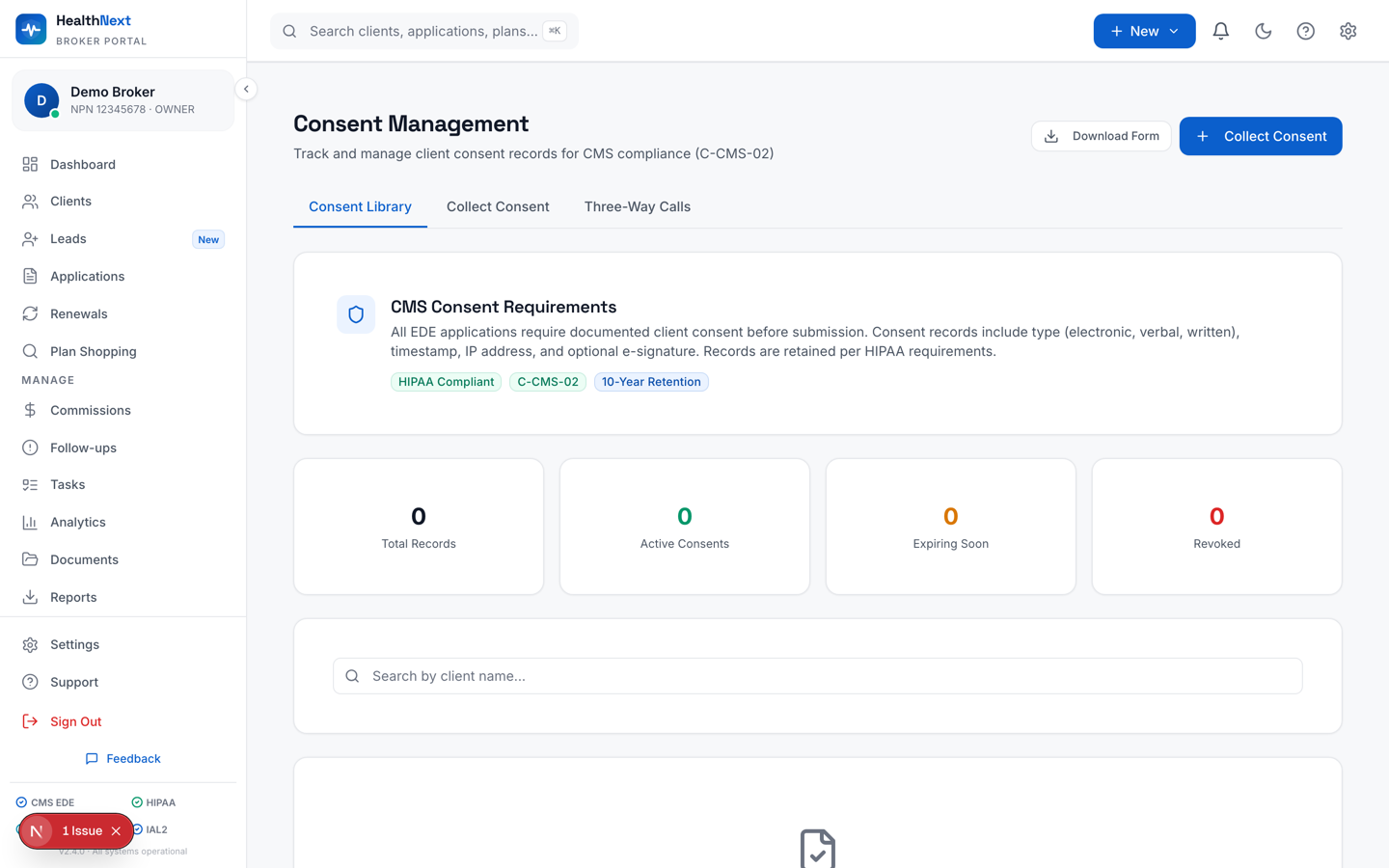
Consent, AOR, and permission Electronic, verbal, written, three-way call, AOR transfer, consent scope, revocation, expiration. ConsentRecord with IP, user agent, timestamp, consumer/agent context, E-SIGN-compatible signature field, audit retention. Consent Library, Collect Consent, Three-Way Calls.
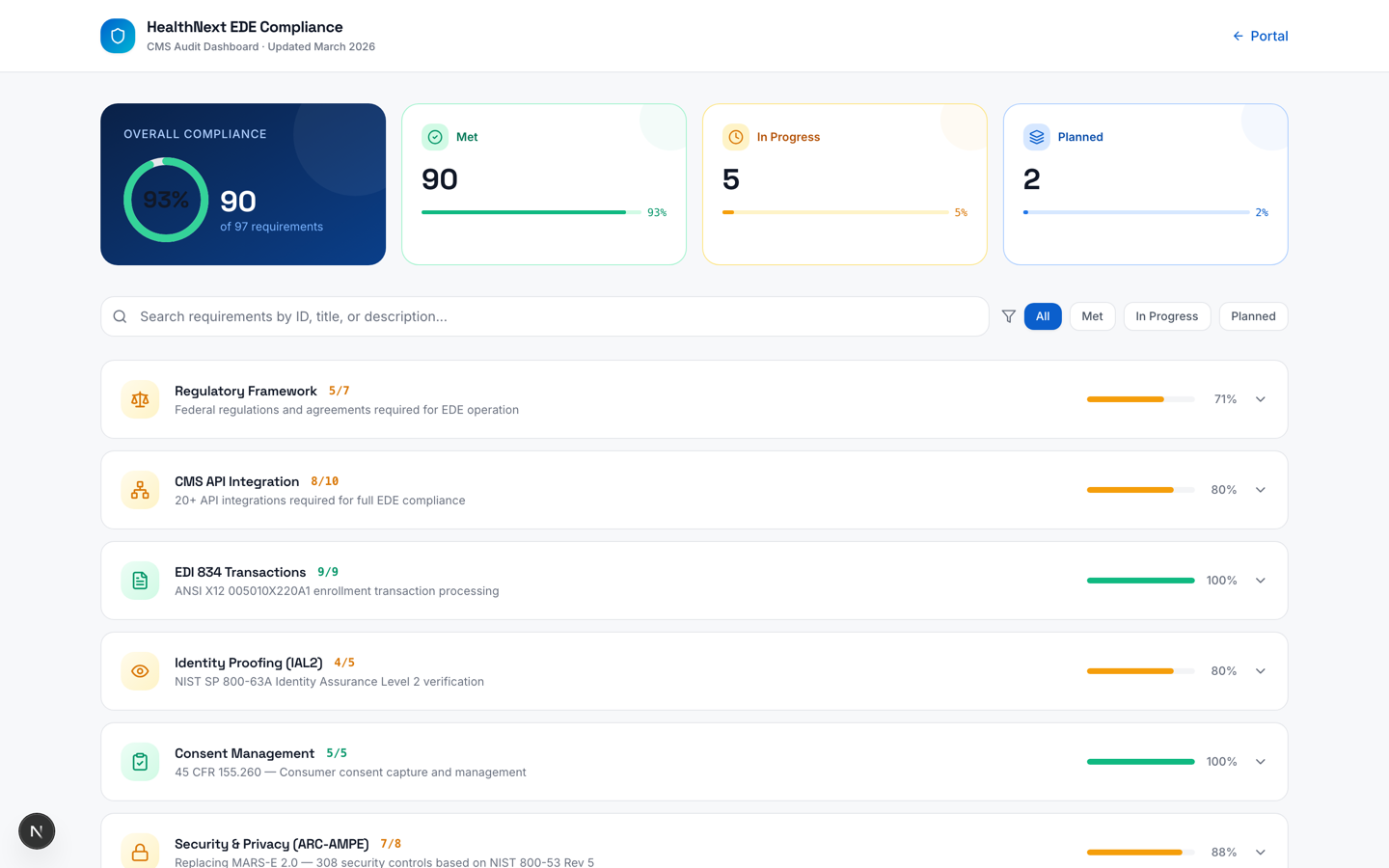
CMS EDE Hub transactions StoreIDProofing, StorePermission, SubmitApp, SubmitEnrollment, GetApp, GetEnrollment, GetDMI, GetSVI, NoticeRetrieval, UpdatePolicy. mTLS-capable keep-alive transport, circuit breakers, idempotency rows for non-idempotent submissions, correlation IDs, evidence capture. Application submit, Compliance, EDE testing evidence.
Carrier and downstream operations EDI 834 generation, 999/997 acknowledgment tracking, carrier appointment context, commissions, exports, payments. Transaction IDs, validation errors, acknowledgment status, retry counts, export controls, commission records. Exports, Commissions, Payments, Reports.
Audit and compliance evidence Compliance artifacts, audit report, audit integrity verification, CMS package, security remediation evidence. AuditLog hash chain, redacted audit metadata, Hub evidence folder, HMAC webhook receipts, generated certification artifacts. Compliance, Audit Report, Evidence Hub.
Platform walkthrough

The platform operates from broker access to enrollment evidence across one governed workflow.

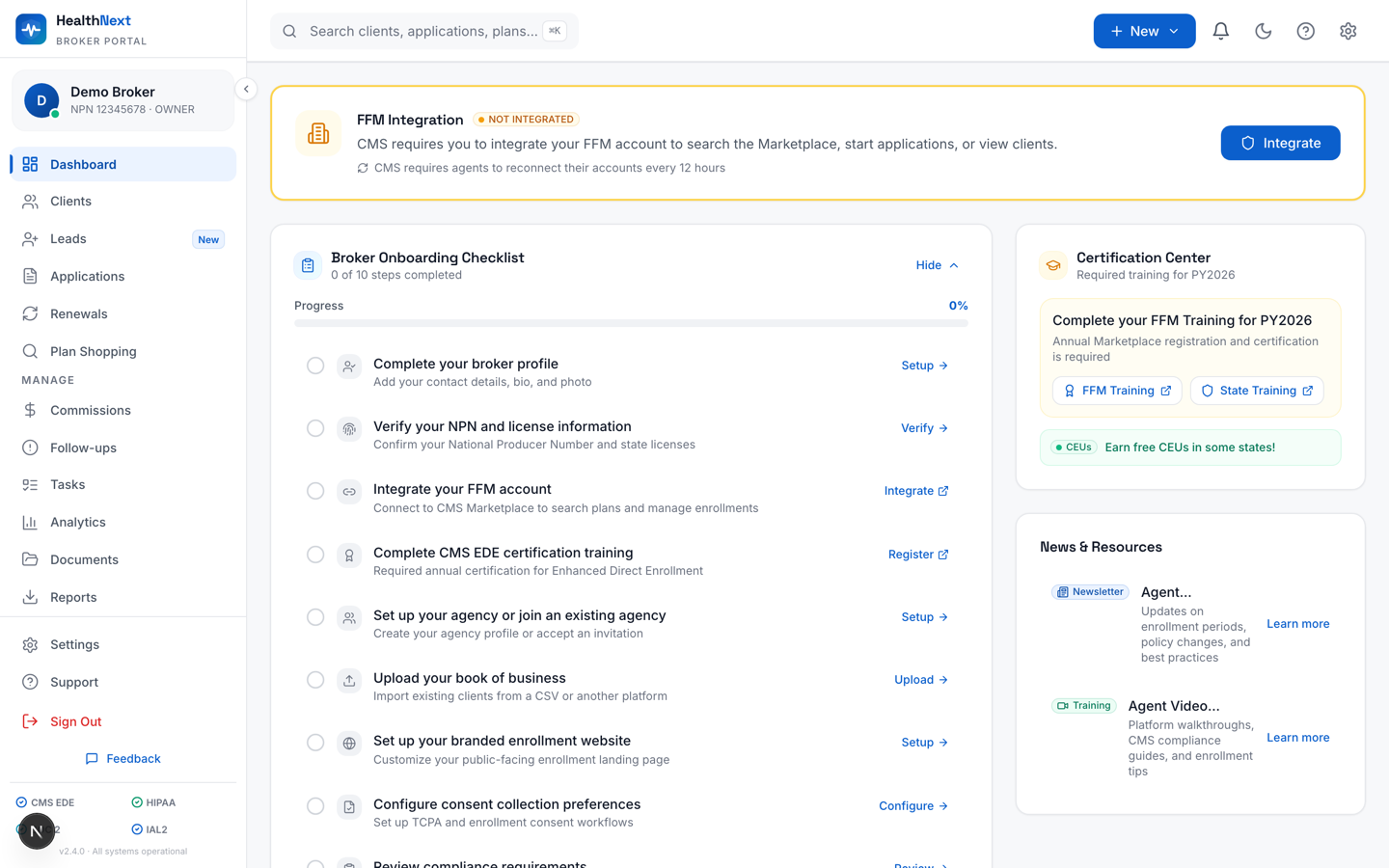
MarketLink is presented through an end-to-end operating sequence: broker readiness, agency governance, book management, application workflow, plan shopping, consent, submission, and compliance evidence.

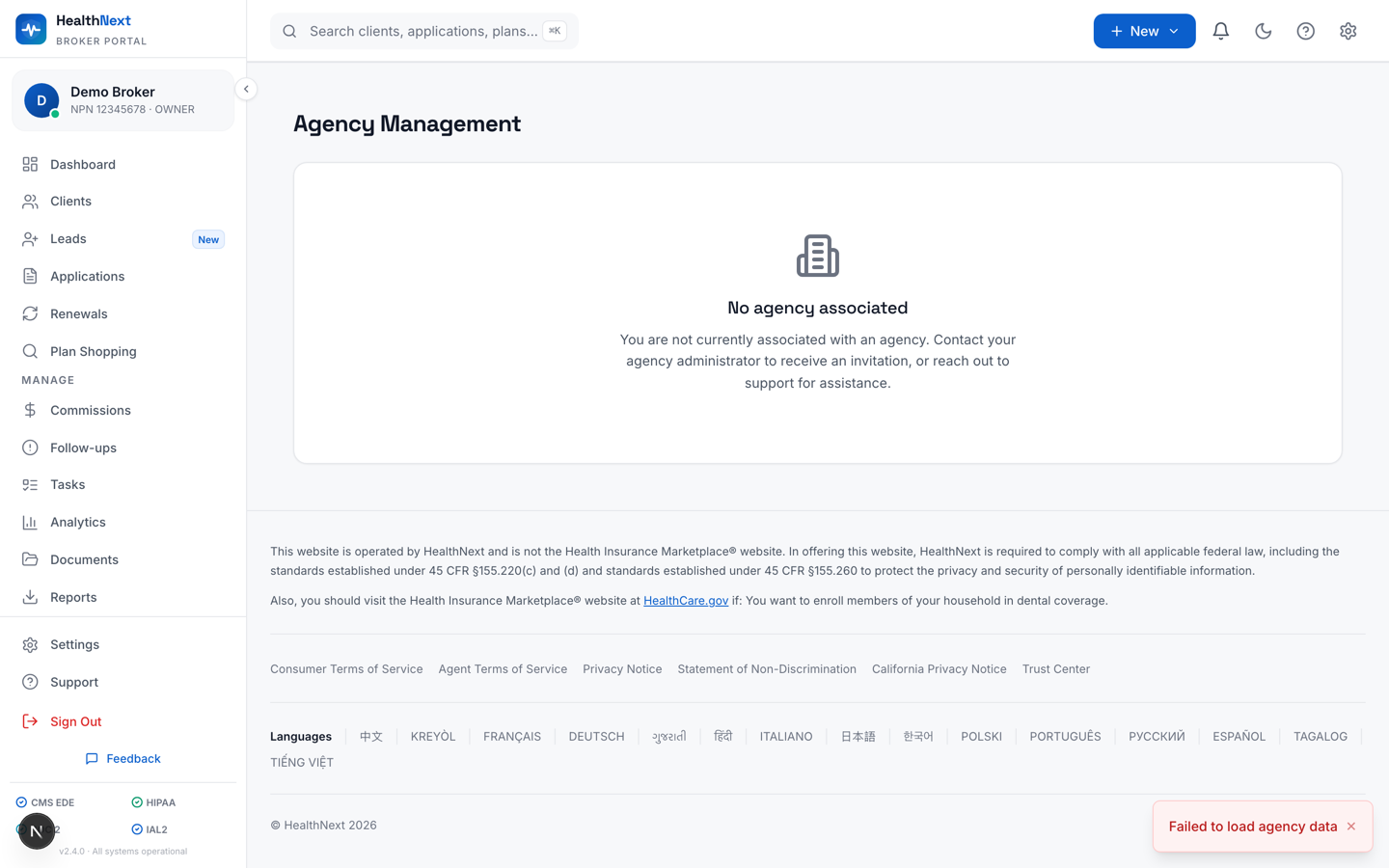
00-02 Access and readiness

Broker dashboard establishes FFM integration status, onboarding readiness, certification training, and operational next steps.

02-04 Agency and agent control

Agency roster, role boundaries, NPN management, carrier appointments, invitations, and approval workflow define controlled access.

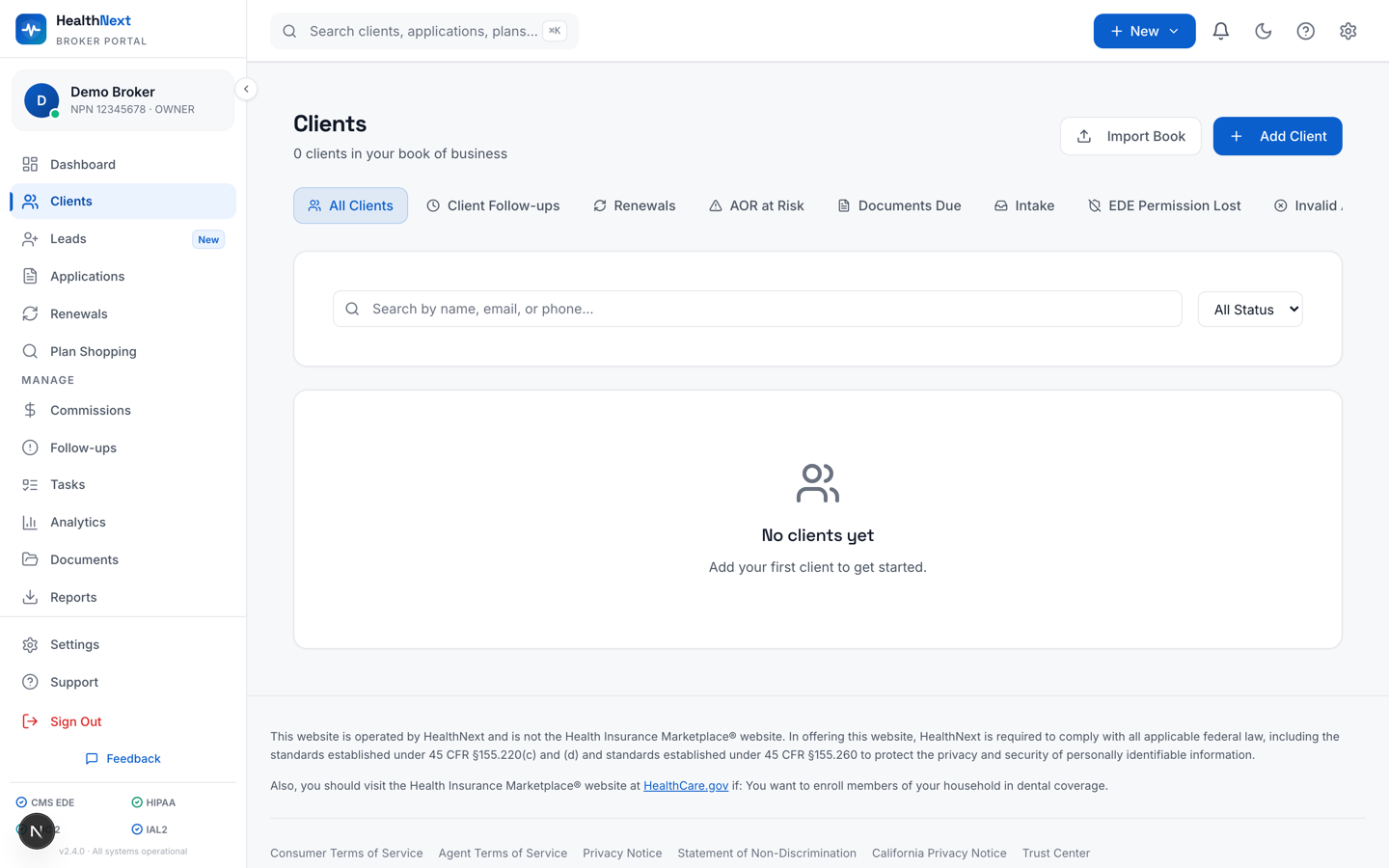
04-06 Book of business

Clients, leads, import, follow-ups, renewals, documents due, AOR at risk, and SVI tracking provide broker operating visibility.

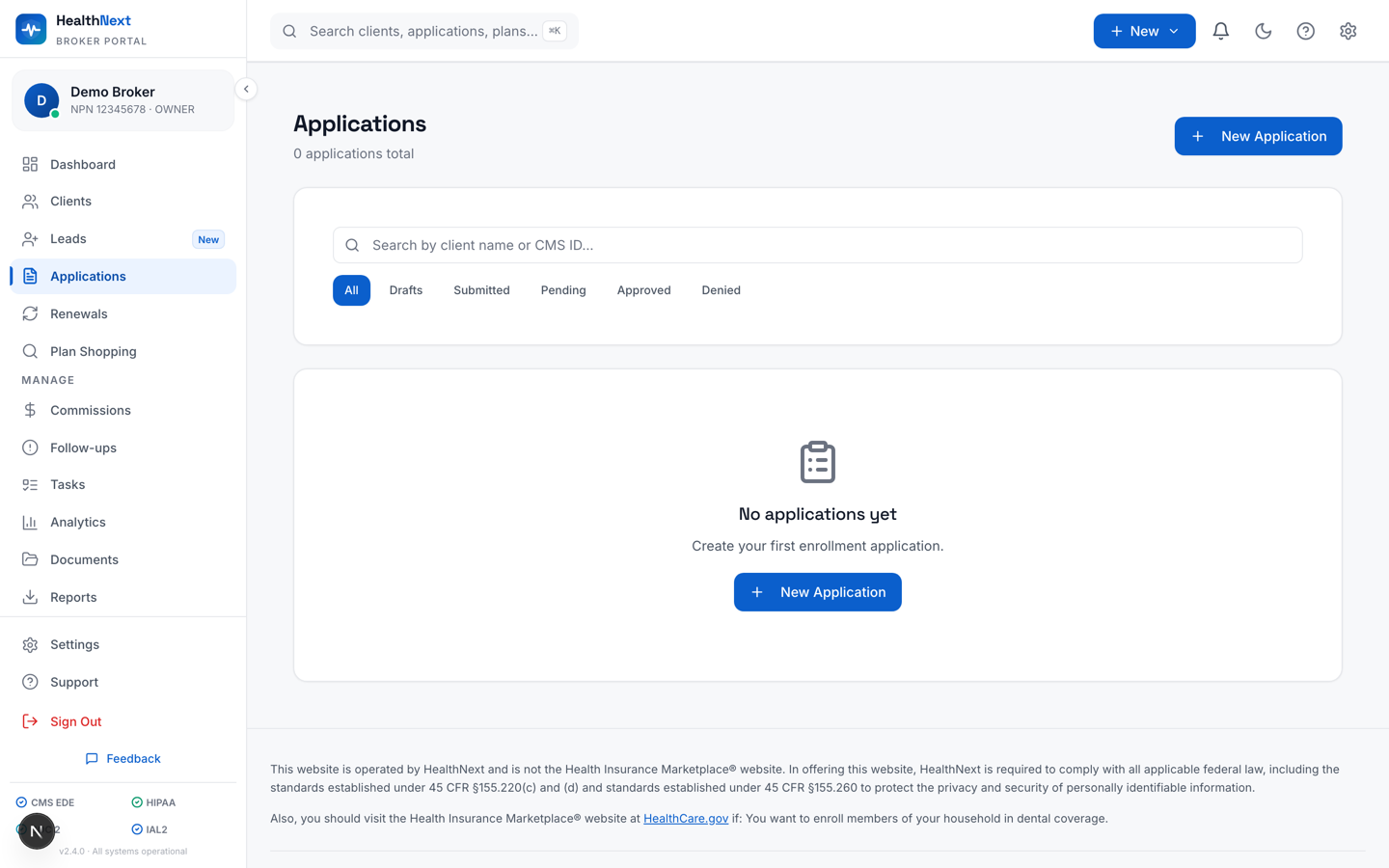
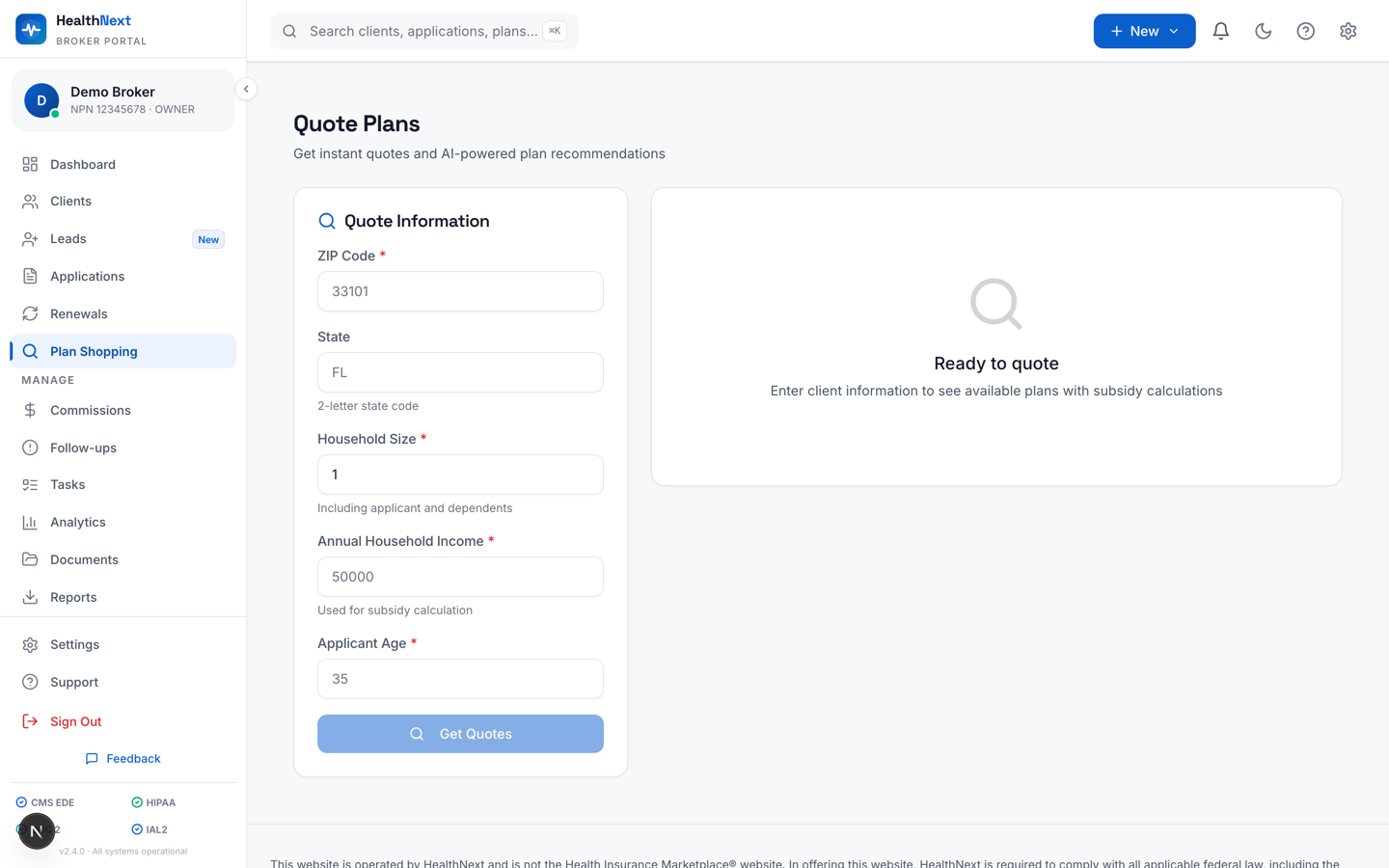
06-09 Application and plan shopping

Application workflow validates household details, calculates APTC/CSR context, compares plans, and selects coverage.

09-12 Consent and submission

Consent, submission, confirmation, review tasks, and consumer notification complete the controlled enrollment path.

12-14 Evidence and operations

Audit report, compliance artifacts, Hub evidence, DMI/SVI remediation, exports, commissions, and support readiness close the loop.
Production readiness priorities

The operating model advances through governed controls, automation, and evidence-backed readiness.

These priorities define the control posture for a regulated ACA enrollment platform: enforce access at the data layer, standardize identity assurance, automate producer validation, formalize CMS contracts, and operate evidence as a managed compliance asset.

Data isolation

Enforce minimum necessary access below the application layer.

Database-level policy for agencyId, brokerId, clientId, and delegated-book access strengthens broker separation and reduces dependency on route-only controls.

Identity

Standardize enterprise SSO, MFA, and session governance.

Producer, agency, support, and consumer pathways should carry verified identity context, MFA enforcement, step-up policy, timeout controls, and clear deprovisioning evidence.

NPN and AOR

Automate producer validation and consent lifecycle controls.

NPN/NIPR validation, RCL status, annual certification evidence, AOR consent, dispute handling, and revocation proof become governed operating services.

Hub contracts

Formalize CMS Hub service contracts and transaction behavior.

Typed request and response schemas, contract tests, replay fixtures, idempotency controls, and correlation IDs create predictable integration behavior for every submission path.

Evidence operations

Operate evidence as a protected compliance system.

Hub evidence, wire metadata, audit logs, DMI/SVI history, and enrollment outputs require governed retention, redaction, access review, and export controls.

Operational continuity

Maintain one governed enrollment record across the full lifecycle.

Broker, agency, agent, consumer, application, selected plan, consent, DMI/SVI activity, 834 transaction, and audit evidence remain connected across every operating view.

Capability baseline

The pathway is grounded in concrete product, security, integration, and evidence capabilities.

The capability baseline links validated platform functions to the security, integration, and evidence controls needed for a corporate-grade broker and consumer enrollment platform.

Product capability Broker workspace, agency model, and consumer entry path

Dashboard readiness, role-aware navigation, broker portal functions, branded entry, application workflow, and EDE operating status.

Broker-agent requirements Broker hierarchy, producer validation, and minimum necessary access

OWNER/ADMIN/AGENT/SUPPORT boundaries, NPN validation, AOR consent, minimum necessary access, and audit evidence.

Security capability Identity, route control, data protection, and tamper-evident audit

Route gates, Okta/IAL2 path, MFA, CSRF, rate limits, geo control, encrypted PII, protected-data logs, and audit row hash.

Integration capability Marketplace services, CMS Hub transport, and downstream enrollment files

Plan search, SLCSP/APTC context, mTLS-ready Hub transport, idempotency, correlation IDs, evidence capture, and downstream carrier enrollment.